03 August 2012

ECCE HOMO

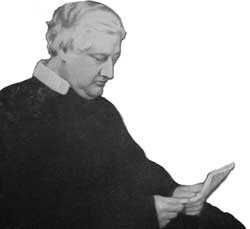
H.T. Henry, Litt.D.
+
ECCE  HOMO !

A plaything of man s hate and pride,
    All worn and wan,
In mocking purple clad new-dyed
With eager streams of life s red tide
    Behold the  Man !

And yet, when senseless we, how feels
    Each senseless thing!
For though a Caesar's be the seals,
Lo, Christ the yielding rock reveals :
    Behold the King !

And now He plans a Wedding-Feast :
    Around His Board
Throng good and bad, and great and least,
The wise, the fool, the scribe, the priest :
    Behold the Lord !
 
Yet meekly, in His altared bliss,
    He wields no rod,
While saints adore, and scoffers hiss,
And friends embrace, and traitors kiss :
    Behold the God ! 

Rt Rev Msgr Hugh T. Henry
Eucharistica
Verse and Prose in Honour of
THE HIDDEN GOD
[Philadephia: The Dolphin Press, 1912]

"Grey is the Devil's Favorite Color"

Dr. Peter Kreeft


The title above is a quote from Dr. Peter Kreeft.  Please read a related article on Catholic World Report regarding Catholic women embracing pornography: link here.

Paragraph 2354 of the Catechism of the Catholic Church: 

Pornography consists in removing real or simulated sexual acts from the intimacy of the partners, in order to display them deliberately to third parties. It offends against chastity because it perverts the conjugal act, the intimate giving of spouses to each other. It does grave injury to the dignity of its participants (actors, vendors, and the public), since each one becomes an object of base pleasure and illicit profit for others. It immerses all who are involved in the illusion of a fantasy world. It is a grave offense. Civil authorities should prevent the production and distribution of pornographic materials.
+

02 August 2012

Our Faith must be beautiful

+
Our Faith must be beautiful if it is to hold souls. Far from us the illusion that it is sufficient to tell our people what to believe and what to do as one gives medicine to a sick person, tasteless or perhaps even unpalatable! Perhaps we priests too readily become the victims of certain well-worn phrases which seem to be the product of lazy shepherds, and which appear to make every dogma just a blow on the head which the believer should receive thankfully.  Some piece of doctrine is given him, not as bread to eat and to enjoy, but as a stone to carry about.  Far from us, I say, such facile belief in our people's readiness to be contented believers; they are hungering and thirsting for the beauties of their Faith, and unless we meet them in their legitimate desires our true contact with souls becomes less and less every year.


(Martin) Anscar Vonier, OSB
Firmly I Believe and Truly
The Spiritual Tradition of Catholic England
An Anthology of Writings from 1483 to 1999
Ed. by John Saward, John Morrill, and Michael Tomko
[2011: Oxford University Press, p. 594]

01 August 2012

Christ in His Heavenly Beauty

John Saward

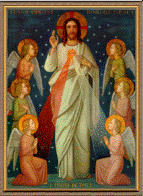
Christ in His heavenly beauty does not shine alone.  There is no splendid isolation in His Godhead, for He is Light from Light, the consubstantial Son and Splendour of the Father, living and reigning with Him in the unity of the Holy Spirit.  And the glory of His manhood is not a private radiance, for He is the Light of the World, the Bridegroom who beautifies the Bride, the Lamb who is the lamp of a lustrous city.  The brightness of Christ’s pierced and risen flesh is incomparable but not incommunicable.  He is ‘beautiful above the sons of men’, and yet ‘grace is poured abroad in [His] lips’ (Ps 44:3). On His right stands the Queen (Ps 44:10), His Virgin Mother, clothed body and soul in His glory, and around her is her court, the numberless multitude made brilliant in His blood.  ‘Ipse est corona sanctorum’, He is the crown of all the saints, ‘Ipse, the only one, Christ, King, Head’.


John Saward
The Beauty of Holiness 
and the Holiness of Beauty:
Art, Sanctity & the Truth of Catholocism
[San Francisco: Ignatius Press]

31 July 2012

Hymn Translation: O Bread of Heaven

+


Holy Mass in the Cathedral of the Most Precious Blood of Our Lord Jesus Christ, City of Westminster, England, 18 September 2010

O Bread of Heaven
Words: St Alphonsus Liguori
Translation: Rev. E. Vaughan C.SS.R.
Music: Tynemouth - H. F. Hemy
Performed by: Westminster Cathedral Choir


O Bread of Heaven, beneath this veil
Thou dost my very God conceal:
My Jesus, dearest treasure, hail!
I love Thee and, adoring, kneel;
Each loving soul by Thee is fed
With Thine own Self in form of Bread.

O food of life, Thou Who dost give
The pledge of immortality;
I live, no 'tis not I that live;
God gives me life, God lives in me:
He feeds my soul, He guides my ways,
And every grief with joy repays.

O Bond of love that dost unite
The servant to his living Lord;
Could I dare live and not requite
Such love - then death were meet reward:
I cannot live unless to prove
Some love for such unmeasured love.

Beloved Lord, in Heaven above
There, Jesus, Thou awaitest me,
To gaze on Thee with endless love;
Yes, thus I hope, thus shall it be:
For how can He deny me Heaven,
Who here on earth Himself hath given?
+

Dr. Margaret Barker: Reading the Meaning

+
"All religious belief is expressed, transmitted and received in code.  even the simplest statements, when they are examined carefully by an outsider, have very little meaning.  This is because every religious community has its own way of speaking about faith, and the most effective way to do this is in pictures.  People brought up in a Christian community recognise immediately what is meant by the Lamb of God, or by bread and wine; to someone from another culture, however, these are not vivd images but a solid wall which separates those inside, those 'in the know', from everyone else. 'Other cultures' are no longer those who can be identified as other faith communities.  The 'other cultures' now are the vast mass of people who have lost all touch with Christian tradition.

"It used to be thought that putting the code into modern English would overcome the problem, and make everything clear to people who had no roots in a Christian community.  This attempt has proved misguided, since so much of the code simply will not translate into modern English.  It was not the words themselves which were the problem, but rather the pictures, the signs and symbols which the words were describing.  The 'blood of the Lamb' is a phrase familiar to all Christians; it is perfectly good modern English, but, unexplained, is meaningless.

"There has also been an attempt to put the Bible, more particularly the New Testament, into a code-free form.  Remove the symbols and the pictures, it was thought, break the pure truth free from the story in which it was unfortunately embedded, and then all would be clear.  The result proved to be exactly the opposite; a fog of contemporary philosophical jargon was offered in place of the vivid symbols and stories of the Bible, and the problem remained.

"The task, then, has had to alter. The need now is not just for modern English, or modern thought forms, but for an explanation of the images and pictures in which the ideas of the Bible are expressed.  These are specific to one culture, that of Israel and Judaism, and until they are fully understood in their original setting, little of what is done with the writings and ideas that came from that particular setting can be understood.  Once we lose touch with the meaning of biblical imagery, we lose any way into the real meaning of the Bible.  This has already begun to happen, and a diluted 'instant' Christianity has been offered as junk food for the mass market.  The resultant malnutrition, even in churches, is all too obvious."


Margaret Barker

"On Earth as it is in Heaven"
[2009: Sheffield Phoenix Press]
pp. 1-2.

Hail, Jesus, Hail: Fr. F.W. Faber

+

HAIL, Jesus, hail! who for my sake
Sweet blood from Mary's veins didst take
And shed it all for me:
Oh, blessèd be my Saviour's blood,
My light, my life, my only good,
To all eternity.

To endless ages let us praise
The precious blood, whose price could raise
The world from wrath and sin:
Whose streams our inward thirst appease
And heal the sinner's worst disease,
If he but bathe therein.

Oh, sweetest blood, that can implore 
Pardon of God, and heaven restore,
The heaven which sin had lost;
While Abel's blood for vengeance pleads,
What Jesus shed still intercedes
For those who wrong him most.

Oh, to be sprinkled from the wells
Of Christ's own sacred blood, excels
Earth's best and highest bliss;
The ministers of wrath divine
Hurt not the happy hearts that shine
With those red drops of his.

Ah, there is joy amid the saints,
And hell's despairing courage faints
When this sweet song we raise:
Oh, louder then, and louder still,
Earth with one mighty chorus fill,
The precious blood to praise. 


[18TH CENT.  TR. F.W. FABER, 1814-62]

THE WESTMINSTER HYMNAL, No. 95 

+

What happened

This post has been removed because it no longer matters.

Anglican Patrimony: On the BVM

+
John Pearson [from An Exposition of the Creed.  On the words of Aricle III, "Born of the Virgin Mary."  Ed. Oxford (E. Burton), 1864, p. 321.  Cp. note on No. 13.]

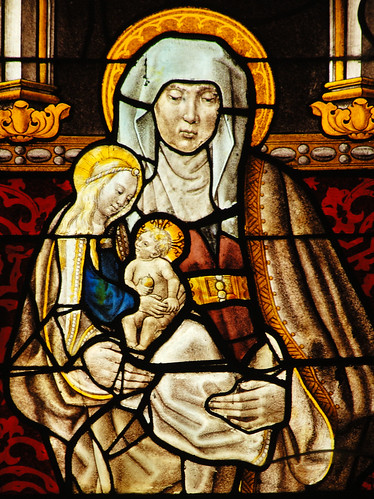
St. Anne, B.V.M., & the Child Jesus*
In respect of her [i.e., of the Blessed Virgin] it was therefore necessary that we might perpetually preserve an esteem of her person, proportionable to so high a dignity.  It was her own prediction, From henceforth all generations shall call me blessed ; but the obligation is ours to call her, to esteem her so. If Elizabeth cried out with so loud a voice, Blessed art thou among women, when Christ was but newly conceived in her womb, what expressions of honour and admiration can we think sufficient now that Christ is in Heaven, and that Mother with Him!  

Far be it from any Christian to derogate from that special privilege granted her, which is incommunicable to any other.  We cannot bear too reverend a regard unto the Mother of Our Lord, so long as we give her not that worship which is due unto the Lord Himself.  Let us keep the language of the Primitive Church.  Let her be honoured and esteemed, let Him be worshipped and adored.
_______
*Image is an East Window in St. Andrew's Hingham
+

30 July 2012

St. Anne's Octave: Her Relics

+
During the Octave of the Feast of St. Anne, I always sit down to read again the story of the miraculous finding of her holy relics by Emperor Charlemagne.  My favourite Church in the world is St. Anne's Catholic Church in Jerusalem, a church with a most marvellous acoustic for bearing aloft the sung praises of God and the worship due His Name. But this story today takes us to southern France during the reign of the great Emperor Charlemagne.  He was greatly devoted to St. Anne and even had her image embroidered upon his coronation robes.  If ever a monarch were to discover the resting place of St. Anne's relics due to personal devotion, Charlemagne was that king.  
 
There are several accounts in English of the discovery of the relics of St. Anne, the Grandmother of the Lord, by a disabled child in the company of Charlemagne.  They all derive from a record kept during the reign of Pope St. Leo III.  One such account may be read on Dr. Taylor Marshall's blog here.   Also, there is a splendid new translation by Kathy Pluth of the Office Hymn for the Feast of St. Anne which one can read here.  Below I post another version of the story of St. Anne's relics and Charlemagne's involvement in their discovery; this version was made available through a Catholic parish named for the Grandmother of the Lord:

"According to most ancient and uninterrupted tradition, the body of St. Anne was carried to Gaul [a province of the Roman empire which included what are now the countries of France and upper Italy] by the same vessel which carried Lazarus and his sisters there. 

"During the first century of the Christian era, these friends of Our Lord were banished from Palestine because of their faith. From their hands St. Anne’s precious remains were taken for safekeeping to the city of Apta Julia, which in our own times is the city of Apt, France. In those stormy days of persecution, it was necessary to hide the relics of the Martyrs and Saints. Consequently, the body of St. Anne was buried in an underground church or crypt. The martyrology of Apt, one of the most ancient in existence, mentions this fact.

"The first bishop of Apta Julia, St. Auspicius, who died before 118, took further precautions to guard this holy treasure from desecration and had the body buried still deeper in the subterranean chapel. All approach to it was carefully concealed till persecutions and invasions should have ceased. For centuries, the
country was repeatedly overrun by hordes of barbarians, and it was only natural that during these agitated years the precise spot where St. Auspicius had carefully hidden his treasure became lost in obscurity. 

"After Charlemagne’s decisive victory over the Saracens at the close of the eighth century, peace and security returned to Gaul. It was then that the people began to restore and rebuild the holy places destroyed or desecrated by the invaders. Priests and bishops of Apta Julia began to seek for the exact spot in the deep crypt where St. Auspicius had hidden and walled up the sarcophagus of St. Anne.

"Charlemagne’s first care on his arrival at Apt was to have the cathedral re-consecrated. This took place during the Easter solemnities, in the presence of an enormous crowd of nobles, clergy and people. But there was one cause of sadness amid all the rejoicing, namely, that every effort to find the remains of St. Anne had proved fruitless. A miracle, however, was to lead to the discovery of her resting place, as is related by Charlemagne in a letter to Pope Adrian I.

"Among the young nobles who accompanied their parents on this occasion was John, a lad of fourteen, the son of Baron Casanova, deaf, dumb and blind from birth. People near the boy in the sanctuary remarked that during the services he was carried away by some overpowering emotion.

"With rapt and upturned face he seemed to be listening to voices from above. Presently, he moved toward the high altar, struck with his staff the steps leading up to it and made signs that they should dig there. His persistence caused considerable disturbance amid the solemn rites, but neither the clergy nor the royal guards could quiet or restrain the youth. Charlemagne was deeply impressed. After Mass, he commanded that the excavation desired by the boy should be made. 

By the hand of Kathleen Anderson
"The altar steps were removed and a door, closed up with huge stones, was revealed. This was the door of the ancient crypt in which St. Auspicius had been accustomed to celebrate the holy Mysteries and to feed his flock with the Bread of Life. Its size and adornments reminded one of the Roman catacombs. 

"No sooner had this door been opened and the flight of steps leading down from it disclosed than the blind boy rushed forward, as if his eyes had been suddenly opened, and led the way into this underground church. Charlemagne now held the boy’s hand and gave orders to keep back the excited multitude. John made signs that they should search farther, and he struck the wall of the crypt, indicating that what they sought lay beyond. 

"When the wall was broken down, another and lower crypt was discovered at the end of a long and narrow corridor. As they came in view of this crypt, a bright light flashed upon the Emperor and his assistants. They beheld, in front of a walled recess, a burning lamp, which flooded the place with unearthly splendor. No sooner, however, had the Emperor and his cortege entered this place, than the lamp went out. But, more wonderful still, at that very moment the blind boy could see, speak and hear. “The body of Saint Anne, mother of the Virgin Mary, Mother of God, is in yonder recess,” were his  first words.

"The awe-stricken Emperor and his followers, at first dumb with amazement, gave vent to their emotion in words of praise and thanksgiving. The walled recess was thrown open, a sweet fragrance like that of oriental balm filled the air, and a casket of cypress wood was discovered containing the body of St. Ann wrapped round and round with folds of precious cloth. On the casket was the inscription: “Here lies the body of Blessed Anne, mother of the Virgin Mary.”

"Charlemagne, with all those present, venerated the sacred deposit thus brought to light. Afterward he had an exact narrative of the discovery drawn up by one of his notaries and a copy sent to the Pope with the royal letter. This letter and the Pope’s answer are still extant. 

The Holy Relics of Apt Cathedral
"The miraculous discovery at once made the Cathedral of Apt the center of attraction for Christian pilgrims from every part of Gaul. In the wars which followed the reign of Charlemagne down to our own times, the clergy and people of Apt have watched with never failing love over the sacred treasure which is the glory of their city. Travelers visiting the venerable Cathedral of St. Auspicius will find piles of ex votos, the indisputable testimonies during eleven centuries of the wonders wrought there by Christ at the intercession of His sainted Grandmother. ..."
+

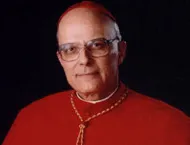
Cardinal George: On "Chicago values"

+
With the rapidly deteriorating situation in the USA with regard to religious liberty, Cardinal George has provided an excellent response to the illiberal positions being taken by the Democratic Party mayors of several large cities.  The context of Cardinal George's statement is with regard to the City of Chicago and its mayor Rahm Emmanuel.

The Cardinal's statement may be read here. 

It is also interesting to note the 'liberal' and 'gay activist' chorus rising in opposition to the Mayor's demagoguery: an example may be found here.
+

Rorate Caeli Blog

J+M+J
The traditional Latin Mass blog Rorate Caeli has taken up the matter of Msgr. Steenson's latest statement:


In other blogs it is alleged that Cardinal Wuerl, Fr Hurd, and Msgr Steenson apparently do not want Ordinariate priests learning how to celebrate the Extraordinary Form of the Mass and are intent on denying them the right or opportunity to celebrate the Extraordinary Form of the Mass.   Some say this is all Cardinal Levada's doing.  Really?

Is any of this true?  And if it is true, what gives these men the right to eviscerate Summorum Pontificum and Anglicanorum coetibus? As is to be expected this points not to all Ordinariates but rather points to a particular problem with the Ordinariate in North America.  (And, yes, it may point to a problem in what was Cardinal Levada's office.)  

Unfortunately, in today's retelling of the story the young child who cries out "The Emperor has no clothes!" gets shot.  Dear readers, where there is smoke, there is fire. 

Of course this development points beyond the Ordinariates toward the whole of the Latin Rite.  Bishops everywhere are doing everything they can to prevent the celebration of the Extraordinary Form of the Holy Mass.

In light of the New Evangelisation, I pray the Vicar of Christ will grant the faculty to celebrate multiple masses to his priests of the Latin Rite so as to meet the needs of the missionary field especially that missionary field of Europe and those of the English-speaking nations. I beg the Holy Father to give every priest the universal Pontifical right to celebrate Holy Mass according to the Extraordinary Form without reference to any other authority between the priest and the Vicar of Christ. 

How else are the priests and People of the Church to get around the Cabal that serves the Shining Darkness, that same Cabal that has its hands clutched to choking around the neck of Holy Mother Church.

+Kyrie eleison imas.