19 February 2007

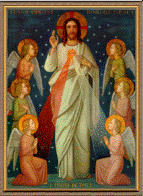
Shrove Tuesday - Feast of the Holy Face of Jesus

St. Therese of the Child Jesus and the Holy Face, pray for us.

There is a wonderful post at Vultus Christi that is most definitely worth reading -- if only for a very fine original translation of the propers for the Shrove Tuesday Feast of the Holy Face of Jesus.

"... Because in the mystery of the Word made flesh, thou hast caused a new light to shine in our hearts, to give the knowledge of thy glory in the Face of thy Son Jesus Ch
rist our Lord." The Book of Divine Worship


Lord, have mercy on us.
Christ, have mercy on us.
Lord, have mercy on us.

Christ, hear us. Christ, graciously hear us.
God the Father of Heaven, have mercy on us.

God the Son, Redeemer of the world, have mercy on us.
God the Holy Spirit, have mercy on us.
+ Holy Trinity, One God, have mercy on us.

Holy Mary, pray for us.
Our Lady of Victory, pray for us.
Saint Therese, servant of God, pray for us.
Saint Therese, victim of the merciful love of God, pray for us.
Saint Therese, spouse of Jesus, pray for us.
Saint Therese, gift of Heaven, pray for us.
Saint Therese, remarkable in childhood, pray for us.
Saint Therese, an example of obedience, pray for us.
Saint Therese, lover of the will of God, pray for us.
Saint Therese, lover of peace, pray for us.
Saint Therese, lover of patience, pray for us.
Saint Therese, lover of gentleness, pray for us.
Saint Therese, heroic in sacrifice, pray for us.
Saint Therese, generous in forgiving, pray for us.
Saint Therese, benefactress of the needy, pray for us.
Saint Therese, lover of Jesus, pray for us.
Saint Therese, devoted to the Holy Face, pray for us.
Saint Therese, consumed with divine love of God, pray for us.
Saint Therese, advocate of extreme cases, pray for us.
Saint Therese, persevering in prayer, pray for us.
Saint Therese, a powerful advocate with God, pray for us.
Saint Therese, showering roses, pray for us.
Saint Therese, doing good upon earth, pray for us.
Saint Therese, answering all prayers, pray for us.
Saint Therese, lover of holy chastity, pray for us.
Saint Therese, lover of voluntary poverty, pray for us.
Saint Therese, lover of obedience, pray for us. .
Saint Therese, burning with zeal for God’s glory, pray for us.
Saint Therese, inflamed with the Spirit of Love, pray for us.
Saint Therese, child of benediction, pray for us. pray for us.
Saint Therese, perfect in simplicity, pray for us. pray for us.
Saint Therese, so remarkable for trust in God, pray for us.
Saint Therese, gifted with unusual intelligence, pray for us.
Saint Therese, never invoked without some answer, pray for us.
Saint Therese, teaching us the sure way, pray for us.
Saint Therese, victim of Divine Love, pray for us.

Lamb of God, Who takest away the sins of the world,
Spare us, O Lord.
Lamb of God, Who takest away the sins of the world,
Graciously hear us, O Lord.
Lamb of God, Who takest away the sins of the world,
Have mercy on us.

V. Saint Therese, the little Flower of Jesus,
R. Pray for us.

Let us Pray:
O God, Who inflamed with Thy Spirit of Love the soul of Thy servant Therese of the Child Jesus, grant that we may also love Thee and may make Thee much loved.
R. Amen.

18 February 2007

Shrovetide

There was a time when we spoke of Shrovetide which was from Quinquagesima and included Shrove Monday and Shrove Tuesday. Shrove Tuesday still survives as a title among some while Mardi Gras or Fat Tuesday seem more and more widespread. As I work to gather up the tattered bits and forgotten gems of our patrimony, I do not want to let Shrovetide go into the dustbin of ecclesiastical parlance. We need to get shriven; we don't need to get beads -- as my Californian Episcopalian friend reminds me via e-mail.

In advance of Ash Wednesday (or Ash Monday if you are Maronite) here follows a prayer by David Silk to consider adding to your devotions:

A Prayer of Devotion to God

Eternal God, I am not my own but yours.
Take me for your own,
and help me in all things to do your holy will.
My God, I give myself to you,
in joy and in sorrow,
in sickness and in health,
in success and in failure,
in life and in death,
in time and for eternity.
Make me and keep me your own;
through Jesus Christ our Lord.

Amen.


17 February 2007

Ancient Preface for the Dedication of a Church

V. The Lord be with you.
R. And with thy spirit.
V. Lift up your hearts.
R. We lift them up unto the Lord.
V. Let us give thanks unto our Lord God.
R. It is meet and right so to do.

IT is very meet, right, and our bounden duty, that we should at all times, and in all places, give thanks unto thee, O Lord holy, Father Almighty, everlasting God:

WHO as the giver of all good things dwellest in this House of Prayer reared by human hands, and by the unceasing operation of thy grace dost sanctify the Church which thou thyself hast founded. And verily thy Church is the true House of Prayer, of which these visible buildings are but the figures. It is the Temple of the habitation of thy glory, the Throne of unchanging truth, the Holy Place wherein everlasting love abideth. It is the Ark which bringeth us, who are delivered from the deluge of the world, into the haven of salvation. It is the beloved and only Bride which Christ hath purchased with his Blood and quickened by his Spirit; in whose bosom we, who have been regenerated by thy grace, are fed with the milk of the Word, are strengthened with the Bread of Life, and are comforted by the help of thy mercy. This is that Bride that on earth, being holpen by the Bridegroom, fighteth the good fight of faith, and being crowned by him in heaven, singeth the songs of triumphant joy.

AND therefore with Angels and Archangels, with Thrones and Dominations, and with all the company of the heavenly host, we sing the majesty of thy glory, evermore praising thee, and saying:

HOLY, HOLY, Holy, Lord God of Hosts, Heaven and earth are full of thy glory. Hosanna in the highest. Blessed is he that cometh in the Name of the Lord. Hosanna in the Highest.

An ancient Eucharistic Preface for the Dedication of a Church.

16 February 2007

An old collect for St. Peter Martyr


Grant we beseech Thee, O almighty God, that we may honor the faith of blessed Peter, Thy martyr, with fitting devotion, as he by the spread of the same faith was found worthy to obtain the palm of martyrdom. Through our Lord Jesus Christ, Thy Son, Who livest and reignest with Thee in the unity of the Holy Ghost, one God, Forever and ever. Amen.


Præsta, quæsumus, omnípotens Deus : ut beáti Petri Mártyris tui fidem congrua devotióne sectemur ; qui pro ejúsdem fídei dilatatióne martyrii palmam méruit obtinére. Per Dóminum.

O God, who didst vouchsafe to blessed Peter thy Martyr to win the crown of martyrdom in the preaching of the Faith : grant, we pray thee ; that we may imitate him in all devout following of the same. Through Jesus Christ our Lord.

More on St. Peter Martyr

Peter Martyr, OP M (RM)(also known as Peter of Verona)

Born in Verona, Italy, 1206; died April 6, 1252; canonized by Pope Innocent IV in 1253--a single year after his death.

Peter's parents belonged to the heretical sect of the Cathari, theological descendants of the Manichees. Miraculously, though he was ridiculed for his faith throughout his youth, it was preserved in purity and he became a Dominican. His father sent him to a Catholic for his early education, thinking that the environment at home would keep Peter from being deceived by the teachings of the Church. Nevertheless, one of the first things Peter learned there was the Apostle's Creed, which the Cathari abhorred. Making conversation one day, his uncle asked him his lesson. The boy recited the creed and explained it in the Catholic sense, especially in those words: Creator of heaven and earth. In vain his uncle tried to persuade him it was false. He said that it was not God, but the evil principle that made all things that are visible; the Cathari viewed the physical world as ugly and bad, which is inconsistent with the concept of an infinitely perfect being. The boy's resolute steadiness concerned his uncle, but his father laughed at his brother's fears believing that the world would corrupt his son.

When he was 15, Peter was sent to the University of Bologna, a hotbed of licentiousness. There he met Saint Dominic, and instantly threw himself at the saint's feet to beg admission to the Order of Friar Preachers. Peter was present at the death of the founder soon after, and shared in the primitive zeal and courage of the sons of a saint. While still a student, Peter experienced a severe trial. He was publicly reprimanded and punished because a brother, passing Peter's cell late at night, thought he had heard women's voices in his room. The voices were those of angels, who frequently visited the saint: but in his humility, he thought it better to accept the punishment and say nothing about the favors God had granted him.

He was sent to the remote little Dominican convent of Jesi, in the marquisate of Ancona, to do penance, and his ordination was delayed. Peter found great strength in prayer. Nevertheless, he was human and felt the sting of the disgrace. One day he complained to the Lord: "Lord, You know that I am innocent of this: Why do you allow them to believe it?" A sorrowful voice replied from the crucifix: "And I, Peter, what have I done that they should do this to Me?" Peter complained no more.

The truth was eventually discovered, and Peter resumed his studies and was ordained to the priesthood. Peter soon became a celebrated preacher throughout northern and central Italy, and, in 1232, an inquisitor to fight against the heresy that had infected his family and others in Lombardy. Many miracles (filling 22 pages in folio in the
Acta Sanctorum) were worked through his prayers, to the rage of the heretics. Crowds nearly pressed him to death many times: some to ask his blessing, others to offer the sick to him to be cured, others to receive his holy instructions.

In one city, a prominent man had been won to heresy, because the devil, taking the form of the Blessed Virgin, appeared at the heretics' meetings and encouraged him to join them. Peter, determined to win the man back to the truth, went to the meeting and, when the devil appeared in his disguise, held up a small pyx in which he had placed a consecrated Host. "If you are the Mother of God," cried Peter, "adore your Son!" The devil fled in dismay and many were converted.

Among other miracles, he predicted that he would be murdered by heretics, who indeed waylaid him on the road between Como and Milan. Peter went to his death singing the Easter Sequence, and fell unprotesting beneath the blows of his assassins. Carino cut his head with an ax, and then his companion Dominic stabbed him. As Peter rose to his knees and commended himself to God, Carino killed him with a blow of his axe to Peter's side. One of his murderers, "Blessed" Carino, was touched by grace at the sight of a saint, was converted, and eventually became a Dominican at Forli. To him as to us, Peter had pointed out the way to heaven when he traced on the dust of the road, in his own blood, the creed that had lighted his path: "Credo in unum Deum." Peter's body was ceremoniously buried in the Dominicans' church dedicated to St. Eustorgius, in Milan, where it still rests. His head is kept separately in a crystal and gold case. So many miracles were worked at his shrine that many of the Cathari asked to be admitted to the Catholic Church (Benedictines, Dorcy, Encyclopedia, Husenbeth).

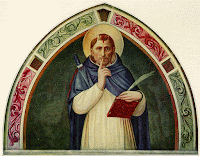
In art, Saint Peter is a Dominican with a gash or knife in his head. Occasionally, the knife is in his shoulder. Sometimes he is portrayed (1) with his finger on his lips; (2) writing
credo in unum deum in the dust as he dies; (3) stabbed in the forest with his companion; or (4) with the Virgin and four female saints appearing to him (Roeder). Peter is the patron of midwives and inquisitors and venerated in Verona (Roeder).

St. Peter of Verona for 2007

St. Peter Martyr has chosen me, and so he shall be my saint for the year 2007.

St. Peter of Verona,
please do pray for me, a miserable offender!


Born at Verona, 1206; died near Milan, 6 April, 1252. His parents were adherents of the Manichæan heresy, which still survived in northern Italy in the thirteenth century. Sent to a Catholic school, and later to the University of Bologna, he there met St. Dominic, and entered the Order of the Friars Preachers. Such were his virtues, severity of life and doctrine, talent for preaching, and zeal for the Faith, that Gregory IX made him general inquisitor, and his superiors destined him to combat the Manichæan errors. In that capacity he evangelized nearly the whole of Italy, preaching in Rome, Florence, Bologna, Genoa, and Como. Crowds came to meet him and followed him wherever he went; and conversions were numerous. He never failed to denounce the vices and errors of Catholics who confessed the Faith by words, but in deeds denied it. The Manichæans did all they could to compel the inquisitor to cease from preaching against their errors and propaganda. Persecutions, calumnies, threats, nothing was left untried.

When returning from Como to Milan, he met a certain Carino who with some other Manichæans had plotted to murder him. The assassin struck him with an axe on the head with such violence, that the holy man fell half dead. Rising to his knees he recited the first article of the Symbol of the Apostles, and offering his blood as a sacrifice to God he dipped his fingers in it and wrote on the ground the words: "Credo in Deum". The murderer then pierced his heart. The body was carried to Milan and laid in the church of St. Eustorgio, where a magnificent mausoleum, the work of Balduccio Pisano, was erected to his memory. He wrought many miracles when living, but they were even more numerous after his martyrdom, so that Innocent IV canonized him on 25 March, 1253.

____________________

I have always had a great love of the Dominican saints and Dominicans in general. And here one of them, St. Peter Martyr (of Verona) has chosen me through the Saint of the Year Devotion. Throughout my life the 25th of March has been the most significant day of the year for many, many reasons. That the Annunciation is the date of the Canonization of St. Peter of Verona, well, I am all astonishment. Yet another amazing convergence is that his Feast Day on the pre-Vatican II calendar reform is now the Feast of St. Catherine of Siena. As an Anglican priest I founded a parish named "St. Catherine of Sienna" and have been deeply devoted to her since university.

I commend this devotion to everyone.

Click on the first words of this post to learn how you too may participate in this devotion.

13 February 2007

The Prayer of Humble Access

The Prayer of Humble Access in the Book of Common Prayer, 1549, read as follows:
We do not presume to come to this thy table (o mercifull lord) trusting in our owne righteousness, but in thy manifold and great mercies: we be not woorthie so much as to gather up the cromes under thy table: but thou art the same lorde whose propertie is alwayes to haue mercie: Graunt us therefore (gracious lorde) so to eate the flesh of thy dere sonne Jesus Christ, and to drynke his bloud in these holy Misteries that we may continuallye dwell in hym, and he in us, that our synfull bodyes may bee made cleane by his body, and our soules washed through hys most precious bloud. Amen.
The prayer was docked by degree (putting "Holy Mysteries" to the axe) until in the American Episcopalian Prayer Book of 1979 it was finally shorn of some very important phrases involving the Body and Precious Blood of Our Lord -- and sadly it is that version that finds its way into the current Book of Divine Worship. HOWEVER, there will come a day for The Book of Divine Worship 2.0, and when it comes I hope The Prayer of Humble Access will look a great deal more like the 1549 Prayer or my suggested revision which follows:

We do not presume to come to this thy Table, O merciful Lord,
trusting in our own righteousness
but in thy manifold and great mercies.
We are not worthy
so much as to gather up the crumbs under thy Table,
but thou art the same Lord whose property is always to have mercy.
Grant us therefore, gracious Lord,

in these Holy Mysteries,

so to eat the Flesh of thy dear Son Jesus Christ
and to drink his Blood

that,
made clean by his Body
and washed through by his most Precious Blood,

we may evermore dwell in him, and he in us
. Amen.


Protestant Text, Catholic Use

The Lutherans in the USA had a 'Common Eucharistic Prayer' once upon a time, and it was shaped in Book of Common Prayer language but its content was judged very Catholic by a number of scholars of an earlier period. I have always thought the prayer astonishingly captivating and was even more astonished by the number of Lutheran clergy who never used it! Be that as it may, I would like to illustrate how a Protestant text might find its way into the Catholic Church when Protestants as a group unite with Rome and are allowed to keep elements of their tradition that are consistent with the Catholic truth.

While it is perhaps doubtful today that this Lutheran 'Common Eucharistic Prayer' would ever serve as the Canon of the Mass in a Catholic context, elements of this beautiful prayer certainly can be drawn together to create a prayer of approach for the Priest and Assembly analogous to the Prayer of Humble Access in the Book of Divine Worship -- that miraculous Book of liturgies for Roman Catholics coming from the Anglican tradition. So here is the prayer as I have edited it, and who can say whether or not such a prayer might not have a future in a revised edition of the Book of Divine Worship ... with broader application in mind:

Priest and People
Holy art thou, Almighty and Merciful God.
Holy art thou, and great is the Majesty of thy Glory.
Thou didst so love the world
as to give thine only-begotten Son,
that whosoever believeth in him might not perish,
but have everlasting life.
Having come into the world
to fulfill for us thy holy will,
he accomplished all things for our salvation.
Remembering therefore his salutary precept,
his life-giving Passion and Death,
his glorious Resurrection and Ascension
and the promise of his coming again,
we give thanks to thee, O Lord God Almighty,
not as we ought, but as we are able;
and we beseech thee mercifully
to accept our praise and thanksgiving,
and with thy Word and Holy Spirit to bless us thy servants,
so that we and all who partake of Christ’s Body and Blood
may be filled with heavenly benediction and grace,
and, receiving the remission of sins,
be sanctified in soul and body,
and have our portion with all thy saints.
And unto thee, O God, Father, Son, and Holy Spirit,
be all honour and glory in thy holy Church,
world without end. Amen.

It may well be argued that this prayer in part repeats what has already been said by the Priest in the Canon. Well, precisely so! Here I might insert some reference to Christifidelis laici but instead let me simply claim the need for repetition of the truths of the Catholic Faith within the Mass itself. Through these internal repetitions and the repeated participation in the Mass, such truths are comprehended and such prayers become not only learnt by heart but also prayers of the heart.

The Collect of the Family Uher

O mighty and merciful God, thou gavest thy Son Jesus Christ to be born of the Blessed Virgin Mary and to be guarded by the just, venerable, and blessed St. Joseph, her most chaste spouse: Keep the Holy Family ever before our eyes so that we may rightly order our own family to the glory of thy Name; through Jesus Christ our Lord who with thee and the Holy Ghost art one God in glory everlasting. Amen.

A personal litany of mine

I pray this Litany both in reparation and for the Anglican Heritage now within the Roman Catholic Church.

O God the Father of Heaven,
................have mercy upon us.
O God the Son, Redeemer of the World,

................have mercy upon us.
O God the Holy Ghost, Sanctifier of the Faithful,

................have mercy upon us.
+ O Holy and Blessed Trinity, One God,
................have mercy upon us.

Our Lady of Glastonbury,
........
........our patroness, pray for us.
Our Lady of Walsingham, pray for us.
Our Lady of Ipswich, pray for us.
Our Lady of Willesden, pray for us.
Our Lady of Ladyewell, pray for us.

St. Joseph of Nazareth,
................Guardian of Christ the Lord, pray for us.
St. Joseph the Just,
................Spouse of the Blessed Virgin Mary, pray for us.
St. Joseph the Builder,
................Patron of the Church, pray for us.

St. John the Forerunner of the Lord, pray for us.
St. Joseph of Arimathea,
................Disciple of the Lord, pray for us.
St. Anne and St. Joachim,
................Grandparents of the Lord, pray for us.

St. Augustine of Canterbury,
................our patron, pray for us.
St. Lucius the Confessor, pray for us.
St. Alban the Martyr, pray for us.
St. Amphibalus of Caerleon, pray for us.
St. Ursula of Cornwall, pray for us.
St. Ninian of Whithorn, pray for us.
St. Patrick, pray for us.
St. Brigid of Kildare, pray for us.
St. Breage of Wales, pray for us.
St. Gwen Teirbron (St. Blanche), pray for us.
St. Gwladys, Queen of Wales, pray for us.
St. Cadfan, pray for us.
St. Illtud, pray for us.
St. Sadwrn of Llansadwrn
St. Palladius, pray for us.
St. Paulinus of York, pray for us.
St. David of Wales, pray for us.
St. Deiniol, pray for us.
St. Maddock (Madog), pray for us.
St. Kenneth (Cynedd), pray for us.
St. Nectan (Nathan), pray for us.
St. Cadfael (Cadog the Wise), pray for us.
St. Gildas the Wise, pray for us.
St. Finnian of Wales, pray for us.
St. Columba of Iona, pray for us.
St. Triduana (Tredwell), pray for us.
St. Ternan of the Picts, pray for us.
St. Servan, pray for us.
St. Kentigern, pray for us.
St. Asaph, pray for us.
St. Constantine of Strathclyde, pray for us.
St. Adamnan, pray for us.
St. Aidan of Lindisfarne, pray for us.
St. Frideswide, pray for us.
St. Theodore of Canterbury, pray for us.
Sts. Mildred, Ermenburga, Milburga, Milgitha, pray for us.
St. Oswald, King of Northumbria, pray for us.
St. Cuthbert of Lindisfarne, pray for us.
St. Hilda of Whitby, pray for us.
St. Wilfrid, pray for us.
St. Benedict Biscop, pray for us.
St.
Elflaeda of Whitby, pray for us.
St. Etheldreda of Ely, pray for us.
St. Aebbe the Elder, pray for us.
St. Cyneburga, pray for us.
St. Edburga of Gloucester, pray for us.
St. Adrian of Canterbury, pray for us.
St. Alfred the Great, pray for us.
St. John of Beverly, pray for us.
St. Bede the Venerable, pray for us.
St. Boniface, pray for us.
St. Lioba, pray for us.
St. Thecla, pray for us.
St. Walburga, pray for us.
St. Dunstan of Canterbury, pray for us.
St. Edith of Wilton, pray for us.
St. Alcuin of York, pray for us.
St. Anselm, Doctor of the Church, pray for us.
St. Edward the Confessor, King of England, pray for us.
St. Margaret, Queen of Scotland, pray for us.
St. Osmund, pray for us.
St. Edmund Rich, pray for us.
St. Hugh of Lincoln, pray for us.
St. William FitzHerbert of York, pray for us.
St. Thomas a Becket of Canterbury, pray for us.
St. Richard of Chichester, pray for us.
St. John Houghton, pray for us.
St. Thomas More, pray for us.
St. John Fisher, pray for us.
St. Cuthbert Mayne, pray for us.
St. Edmund Campion, pray for us.
St. Margaret Clitheroe, pray for us.
St. John Rigby, pray for us.
St. Philip Howard, pray for us.
St. Anne Line, pray for us.
St. Ralph Sherwin, pray for us.
St. John Southworth, pray for us.
St. Richard Gwyn, pray for us.
St. Robert Southwell, pray for us.
St. Nicholas Owen, pray for us.
St. John Ogilvie, pray for us.
St. Margaret Ward, pray for us.
St. Swithun Wells, pray for us.
St. Alban Roe, pray for us.
St. Oliver Plunkett, pray for us.
Blessed Martyrs of England, Ireland, Scotland, and Wales,
pray for us.

O HOLY Ghost the Lord, who on Pentecost gavest the Church the gift of tongues that Christ might be known, loved and served by peoples of divers nations and customs: watch over the Anglican heritage within thy Church, we pray thee, that, led by thy guidance and strengthened by thy grace, that Anglican Heritage may find such favour in thy sight that its people may increase both in holiness and number, and so show forth thy glory; who livest and reignest with the Father and the Son, one God world without end. Amen.

12 February 2007

The Mozarabic Genius in Liturgy

A Mozarabic Prayer to Jesus Our Master
Jesus, our Master, meet us while we walk in the way, and long to reach the heavenly country; so that, following your light we may keep the way of righteousness, and never wander away into the darkness of this world's night, while you, who are the Way, the Truth, and the Life, are shining within us; for your own name's sake. Amen.


A Mozarabic Benediction
A Blessing from an edition of the Mozarabic Sacramentary
May the infinite and glorious Trinity,
the Father , the Son, and the Holy Spirit,
direct our life in good works,
and after our journey through this world,
grant us eternal rest with the saints.
Amen.

Mozarabic 10th century Hymn
Attende Domine

R. Attende Domine, et miserere, quia peccavimus tibi.

V. Ad te Rex summe, omnium redemptor, oculos nostros sublevamus flentes: exaudi, Christe, supplicantum preces. R.

V. Dextera Patris, lapis angularis, via salutis, ianua caelestis, ablue nostri maculas delicti. R.

V. Rogamus, Deus, tuam maiestatem: auribus sacris gemitus exaudi: crimina nostra placidus indulge. R.

V. Tibi fatemur crimina admissa: contrito corde pandimus occulta: tua Redemptor, pietas ignoscat. R.

V. Innocens captus, nec repugnans ductus, testibus falsis pro impiis damnatus: quos redemisti, tu conserva, Christe. R.

+ + + + + + + + + +

Hearken, O Lord -- a translation of Attende Domine
Mozarabic 10th Century Hymn

R. Hearken, O Lord, and have mercy, for we have sinned against Thee.

V. Crying, we raise our eyes to Thee, Sovereign King, Redeemer of all. Listen, Christ, to the pleas of the supplicant sinners. R.

V. Thou art at the Right Hand of God the Father, the Keystone, the Way of salvation and Gate of Heaven, cleanse the stains of our sins. R.

V. O God, we beseech Thy majesty to hear our groans; to forgive our sins. R.

V. We confess to Thee our consented sins; we declare our hidden sins with contrite heart; in Thy mercy, O Redeemer, forgive them. R.

V. Thou wert captured, being innocent; brought about without resistance, condemned by impious men with false witnesses. O Christ keep safe those whom Thou hast redeemed. R.


Servant and Mother of the Word
"O most holy Servant and Mother of the Word" -- a very striking title for the Virgin Mother Mary found in a number of seventh century Mozarabic prayers including a prayer attributed to St. Ildefonso of Toledo...

Virgo Genetrix
The Mozarabic feast of the "glorious and holy Virgin Mary" established in 656 to be observed on December 18th, began with a direct address to the Holy Virgin, which would be found in other rites but not in Rome proper:

"Virgo genetrix et humani generis reparatrix;
implorantium preces auribus offer divinis"


("Virgin, who generated Christ, reparatrix for the human race,
present to the Divine attention (ears) our prayers of supplication.")


From ancient texts

From the Strasbourg Papyrus


Over this sacrifice and offering we pray and beseech thee, remember thy holy and only Catholic Church, all thy peoples and all thy flocks. Provide the peace which is from heaven in all our hearts, and grant us also peace in this life.


From the Divine Liturgy of St. Mark


Through his wisdom, the Lord created the world, the heavens, and the choirs of stars. Through his loving-kindness he made us in his image and likeness. He saved us through his mercy and blessed our mortal frames with grace upon grace.

A beautiful section from a version of the Divine Liturgy of Sts. Addai and Mari


Worthy of glory from every mouth
and thanksgiving from every tongue
and praise from every heart
is the Name above all names,
the Name worthy of all worship,
the Name of the Father, and of the Son, and of the Holy Spirit.